
UGC vs Stock Footage: Why Brands Are Choosing Creators Over Libraries
Industry · Understanding Your Value
UGC vs Stock Footage: Why Brands Are Choosing Creators Over Libraries
Stock footage is widely available and costs a fraction of what brands pay UGC creators. So why are more brands moving their budgets toward real creators instead? Here is a clear breakdown of what UGC and stock footage each actually deliver and why the difference shows up directly in ad performance.
If you have ever had to explain to someone why a brand would pay a creator several hundred dollars for a 30-second video when stock footage exists, this post gives you the answer. And if you are a UGC creator trying to understand your own value proposition more clearly, the comparison is even more useful, because it gets to the root of what you are actually selling.
The short version is this: stock footage sells a visual. UGC sells a person. And in the context of paid advertising.. where the goal is to convert a skeptical stranger into a paying customer, those two things perform very differently.
This post breaks down the comparison across every dimension that matters to a brand: performance, cost, authenticity, flexibility, and scalability. By the end you will have a clear picture of why brands choose UGC, where stock footage still makes sense, and what that means for your positioning as a creator.
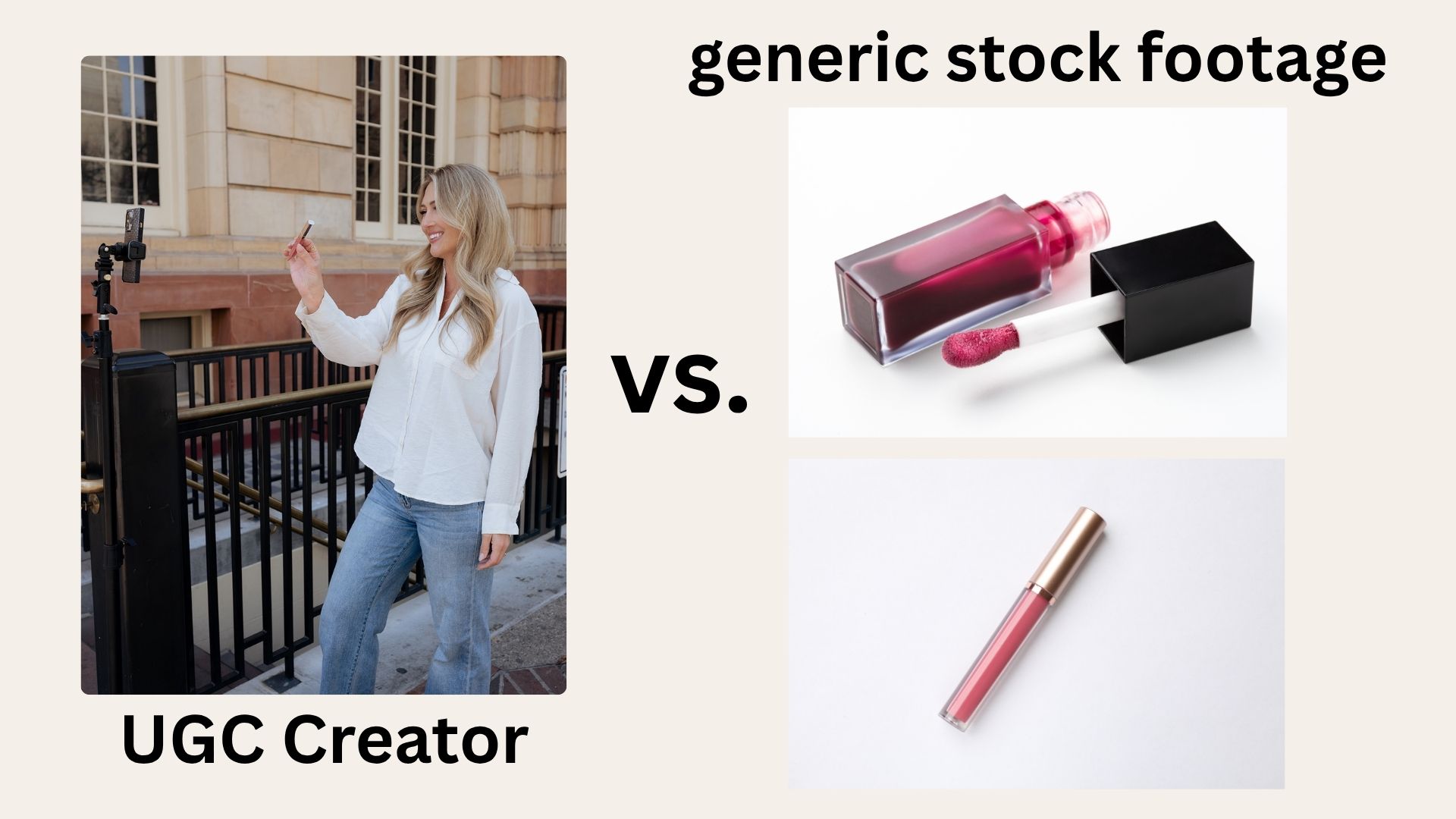
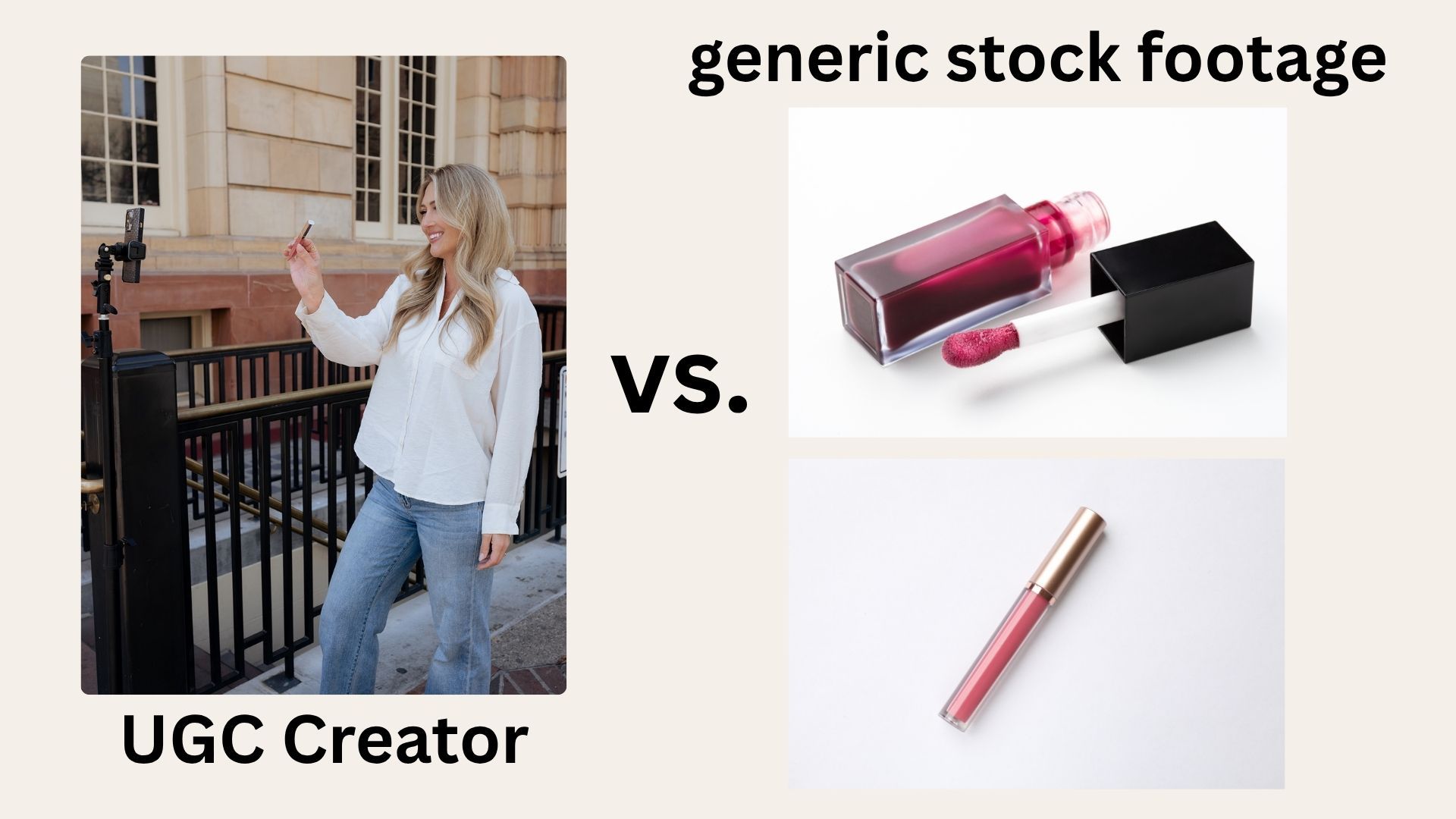
Stock footage shows what a product looks like. UGC shows what it is like to use it. For a brand trying to convert a skeptical audience, those are not the same thing.
Stock Footage and UGC Are Not Competing for the Same Job
Stock footage is pre-recorded video content available through licensing libraries — Shutterstock, Getty Images, Pond5, and similar platforms. Brands pay a licensing fee to use it in their marketing. The footage is generic by design: a woman smiling at her phone, a man jogging in a park, a close-up of hands typing. It is produced to be universally applicable, which also makes it universally impersonal.
UGC — user generated content in the brand marketing sense — is content created by a real person specifically for a brand or product. It features that person's face, voice, and genuine (or spec) experience with the product. It is produced to feel personal, authentic, and native to the platform where it will run.
Brands that understand performance advertising do not think of these as interchangeable. They use them differently, for different objectives, at different stages of their marketing funnel. The confusion mostly comes from brands that are newer to content marketing and are comparing options based on cost alone — which is exactly why UGC creators need to be able to articulate their value clearly when the subject comes up.
UGC vs Stock Footage: The Direct Comparison
Ad Performance and Conversion
UGC consistently outperforms polished stock-based ads in direct response and conversion-focused campaigns. The reason is trust. Viewers process a real person speaking to them differently from a produced commercial built on stock visuals. The authenticity signal — even when the content was created professionally by a paid creator — triggers a social proof response that generic footage cannot replicate. Meta and TikTok's own data have repeatedly shown that creator-driven content drives stronger click-through and conversion rates than traditional ad formats for most product categories.
Authenticity and Relatability
Stock footage is immediately recognizable as stock footage — the lighting is too perfect, the people are too polished, and the scenarios are too clean. Audiences have become very good at pattern-matching branded content, and stock-heavy ads trigger a mental skip response. UGC looks like what someone actually filmed on their phone about a product they actually tried, which is the closest thing to a peer recommendation that a paid ad can deliver.
Product Specificity
Stock footage cannot show your specific product. It can show a person applying serum, but not your serum. It can show someone using a laptop, but not your software. UGC is created around the specific product, showing it in real use in real hands. That specificity is essential for e-commerce brands and direct-to-consumer products where showing the actual item is critical to the purchase decision.
Cost
Stock footage is cheaper upfront. A licensing fee for a stock clip might run $50 to $300 depending on the platform and usage rights, compared to $150 to $500 or more for a UGC video. But cost per acquisition — the metric that actually matters in performance advertising — consistently favors UGC when the content is well-executed. A cheaper ad that converts at half the rate is not a better deal. Brands that understand their numbers know this.
Platform Fit
TikTok and Instagram Reels are built around creator-driven, native-feeling content. Stock footage edited into a 15-second vertical ad looks out of place and performs accordingly. UGC is natively formatted for these platforms — it was designed to blend in with the organic content that surrounds it. As social commerce grows and more brand spending moves to short-form video, the platform fit advantage of UGC over stock continues to widen.
Scalability and Creative Testing
Brands running performance advertising need to test multiple creative variations constantly to find what works and avoid ad fatigue. Stock libraries have finite relevant content for any given product. UGC creators can produce multiple angle variations, hook tests, and format variations on demand. For brands running active paid ad campaigns, having a roster of reliable UGC creators is a production advantage that a stock library cannot replicate.

Where Stock Footage Still Makes Sense for Brands
Being honest about this matters — because understanding where stock footage is still the right tool helps you understand where UGC is irreplaceable, which is the more important thing to know.
Stock footage still makes sense for brands that need visual B-roll to support a longer-form video or brand film. scenery, atmosphere, generic lifestyle visuals that supplement rather than anchor the content. It makes sense for businesses that need website background video, explainer animations, or corporate presentations where authenticity is not the primary objective. And it makes sense in categories where no real person would realistically be filmed using the product. Industrial equipment, enterprise software, and certain B2B contexts where the product does not lend itself to a creator-style review format.
What stock does not work well for is direct response advertising on social platforms where the goal is to stop a scroll, build trust quickly, and move someone to click or buy. That is the job UGC was built for and it is the fastest-growing segment of brand marketing budgets.
Why This Comparison Matters for Your UGC Business
Understanding the UGC versus stock footage distinction is not just useful trivia. It is the foundation of how you articulate your value to every brand you work with.
7 ways the UGC vs stock comparison helps your business
The creators who earn the most are not just good on camera. They understand why brands need what they make — and they can articulate that value clearly and confidently in every conversation.
Simple rule
When a brand pushes back on your rate by saying they can get stock footage for less, the answer is not to lower your price. It is to shift the conversation to performance: stock footage shows a product, UGC sells it. If they are running paid ads, they need the version that converts. That is you.
Build a real business
Learn to Run Your UGC Business Like a Professional
Positioning, pricing, pitching, and the systems that build consistent income. Our courses cover the full business side of being a UGC creator.
UGC Starter Guide
New to UGC? Understand how the business model works before your first deal.
Download Free GuideFiverr Fast Track
Build a Fiverr profile that handles contracts, payments, and revisions automatically.
Build Your Fiverr ProfileUGC Business Blueprint
Content, clients, contracts, pricing, and consistent income. The complete professional system for building a real UGC business.
Start Building Your UGC BusinessHI, WE'RE TAMI & BECCA